
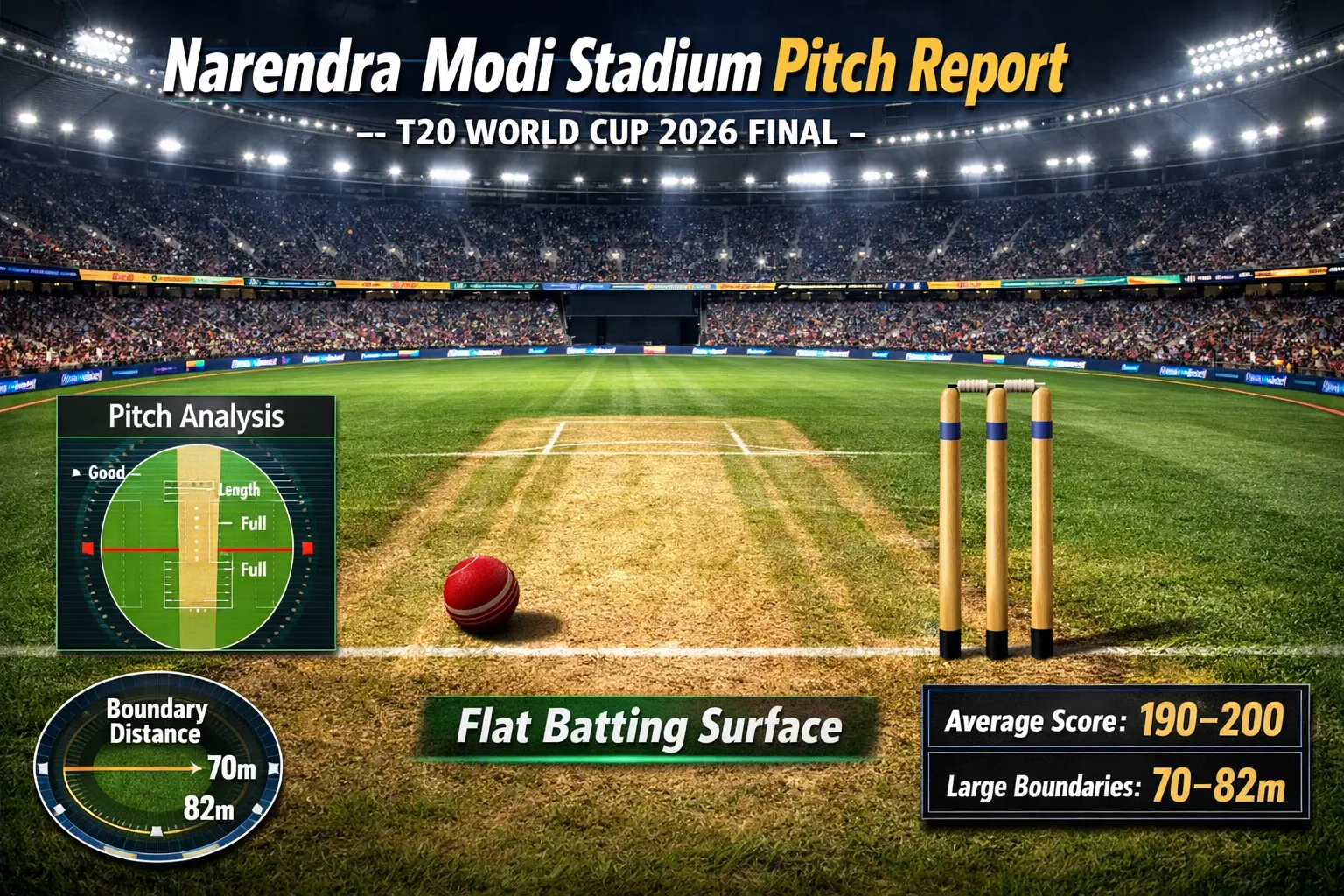
Sunday. Ahmedabad. 1,32,000 people. The Narendra Modi Stadium pitch report for the T20 WC 2026 Final is what every analyst, captain and fan needs to read before a ball is bowled, because on a ground this big, with conditions this specific, the pitch and the toss could matter just as much as the players.
India have been here before. New Zealand, for all their consistency in knockout cricket over the years, have not won a World Cup Final yet. The venue suits one side slightly more than the other and by the end of this piece you will understand why.
The Surface: Flat, Fast and Loaded With Runs
The Narendra Modi Stadium runs 11 centre pitches and the variety between them is actually quite interesting. The ground staff work with both Black soil and Red soil strips, and whichever one gets the nod for Sunday will shape how both teams set their XI.
Black soil is what this ground is most famous for producing. Batters love it here because the bounce is true, the pace comes on nicely and there is very little lateral movement to worry about in the first ten overs. You can play your shots early, trust the surface and just bat. Both teams have the firepower to take full advantage of that.
Red soil changes things. Not dramatically, but enough. Spinners get a bit more grip as the evening wears on and if Varun Chakravarthy or Mitchell Santner are operating on a surface that is offering even a hint of turn in the back half of an innings, that becomes a genuine tactical weapon. Worth keeping an eye on which soil is confirmed in the hours before the game.
Either way, 190 to 200 is the competitive benchmark here. The ICC’s own assessment of this venue describes the surface as a batter’s paradise. Get past 200 and you are in business. Fall short of 180 and you are in trouble regardless of conditions.
Black Soil vs Red Soil Pitch Breakdown
| Factor | Black Soil | Red Soil |
|---|---|---|
| Bounce | True and even | Slightly uneven later |
| Pace off pitch | Good throughout | Slows as match progresses |
| Spin | Minimal assistance | Noticeable grip from overs 10 onwards |
| Best suited for | Power hitters and pace bowlers | Wrist spinners and cutters |
| Key India player | Sanju Samson, Hardik Pandya | Varun Chakravarthy |
| Key NZ player | Glenn Phillips, Finn Allen | Mitchell Santner |
The Dew Factor: The Real Match Winner Nobody Talks About Enough
Both captains know this already, but for everyone watching from home, here is the thing that will likely decide this final more than anything else on the night.
The match starts at 7:00 PM IST. By that point the temperature has already dropped from a daytime high of 38 degrees Celsius down to somewhere around 21 to 26 degrees. Humidity sits between 28 and 50 percent through the evening. That combination, a cooling ground, residual warmth in the pitch and rising humidity, is precisely the environment in which heavy dew settles.
From around the 13th or 14th over of the second innings, the ball gets wet. Not slightly damp. Wet. Bowlers lose their grip on variations, slower balls skid through instead of dying, and yorkers that would land perfectly in dry conditions instead full-toss into a batter’s arc. The chasing side has benefited from dew conditions at this ground consistently in recent night games.
So the toss matters enormously. Winning it and choosing to bat first removes that variable entirely. Losing it and being asked to bowl second in an Ahmedabad dew-heavy evening is genuinely difficult. Both coaches will have spoken about this at length this week and whoever calls correctly on Sunday has already won a small but meaningful advantage before a single delivery is sent down.
Dew Impact by Innings Stage
| Innings Stage | Dew Level | Impact on Bowlers | Impact on Batters |
|---|---|---|---|
| Overs 1 to 8 | Minimal | Full grip, variations effective | Normal conditions |
| Overs 9 to 13 | Building | Slower balls losing effectiveness | Ball coming onto bat better |
| Overs 14 to 17 | Moderate | Yorkers skidding, grip reduced | Easier to hit through the line |
| Overs 18 to 20 | Heavy | Very difficult to control variations | Significant batting advantage |
Narendra Modi Stadium Pitch Report T20 WC 2026 Final: By the Numbers
The ground’s T20I record over the last ten matches is worth understanding properly before making any prediction. The average first innings score here sits between 173 and 192. Teams batting second average between 151 and 173. On the face of it that looks like a batting first advantage, and the toss data backs that up too, with 70 percent of sides winning the toss here electing to bat first in recent matches.
The highest total recorded at this venue is 234/4, set by India against New Zealand of all opponents. The lowest is 66, also against New Zealand, though that one was a collapse rather than a pitch story. The range between those two numbers tells you how much the conditions on a given night can influence the outcome here.
Venue T20I Record (Last 10 Matches)
Boundaries, Lights and the Bits That Catch Teams Off Guard
The boundary dimensions at Narendra Modi Stadium are on the larger side. Straight boundaries run from 70 to 82 metres and square of the wicket sits between 60 and 73 metres. Shots that clear the rope comfortably at smaller T20 venues will not necessarily do so here, meaning hard running between wickets and absolute clean striking matter more than usual.
One detail that regularly catches fielders off guard, particularly those playing here for the first time. The LED ring lighting system the stadium uses eliminates shadows across the playing surface, which sounds like a positive and mostly is. But the white backdrop it creates against the night sky makes high catches genuinely difficult to track for fielders positioned in the deep. It sounds minor until someone grasses a crucial one in the 19th over.
A Ground Unlike Any Other on Earth
There is no cricket ground in the world quite like this one and it is worth saying so plainly. The capacity of 1,32,000 makes it roughly 30 percent bigger than the Melbourne Cricket Ground and twice the size of Eden Gardens. Its design uses Y-shaped columns that remove the need for any support pillars inside the bowl, meaning every one of those 1,32,000 spectators has a completely clear view of the pitch.
Getting that many people in and out safely required serious engineering. A specialised ramp system allows 60,000 fans to enter or exit at the same time. The roof structure uses a lightweight Japanese PTFE tensile membrane and sits completely independent of the seating bowl, an intentional seismic design given Ahmedabad sits in a level three earthquake zone. The roof and the stands can physically move separately if required.
On Sunday night none of that engineering will cross anyone’s mind inside the ground. What will matter is runs, wickets and whether India can defend a title they have already made look like it belongs to them.
India vs New Zealand T20 World Cup 2026 Final: Who Does This Ground Favour?
Honestly, India. Not overwhelmingly, but enough to matter.
They know this ground, they know these conditions and their death bowling unit has shown throughout this tournament that even under dew they can execute under pressure. Bumrah’s six-run over in the semi-final came on a ground with similar evening conditions. That kind of composure does not arrive by accident.
Tactical Toss Guide
| Toss Decision | Advantage | Risk |
|---|---|---|
| Bat First | Avoids dew entirely, sets a target on a fresh surface | No knowledge of opposition total, harder to pace innings |
| Chase | Know the target, dew assists in death overs | Bowling first in heat, defending against dew in overs 14–20 |
| Recommendation | Bat First – Dew at Ahmedabad in March evening games is consistently heavy | |
New Zealand will be studying the same data. They know what 190 looks like and they know how to chase. But Narendra Modi Stadium on a Sunday night in March, with dew coming in from the 13th over and 1,32,000 Indians making the kind of noise that this ground generates, is about as difficult a Final environment as touring cricket gets.
India vs New Zealand Head to Head at This Venue
| Match | Winner | 1st Innings Score | 2nd Innings Score | Margin |
|---|---|---|---|---|
| T20I 2023 | 🇮🇳 India | 234/4 | 173/8 | India won by 61 runs |
| T20I 2021 | 🇳🇿 New Zealand | 164/6 | 66 | New Zealand won by 73 runs (bowled out) |
| ODI 2023 | 🇮🇳 India | 214/7 | 117 | India won by 97 runs |
Stay with us for a full India vs New Zealand T20 World Cup 2026 Final Match Prediction where we break down the playing XI, the key matchups and who we think holds the trophy when Sunday night is done.